When you send documents to an API, you are trusting a third party with your business-critical data. Whether it’s financial reports, legal contracts, or patient records, security isn't just a checkbox - it’s the primary factor in deciding which file conversion service to integrate into your systems.
As the CISO of ConvertAPI, I regularly speak with enterprise customers and developers about how we handle uploaded files, our compliance standards, and our data protection mechanisms. Transparency is a core value for our entire team. In this post, I want to take you under the hood of ConvertAPI’s security architecture and explain the technical measures we use to keep your files protected end-to-end.
Securing File Uploads and No Persistent Storage
The security lifecycle of your data begins the moment an API request is made. Our approach is designed to minimize exposure, enforce strict transport security, and limit data retention.
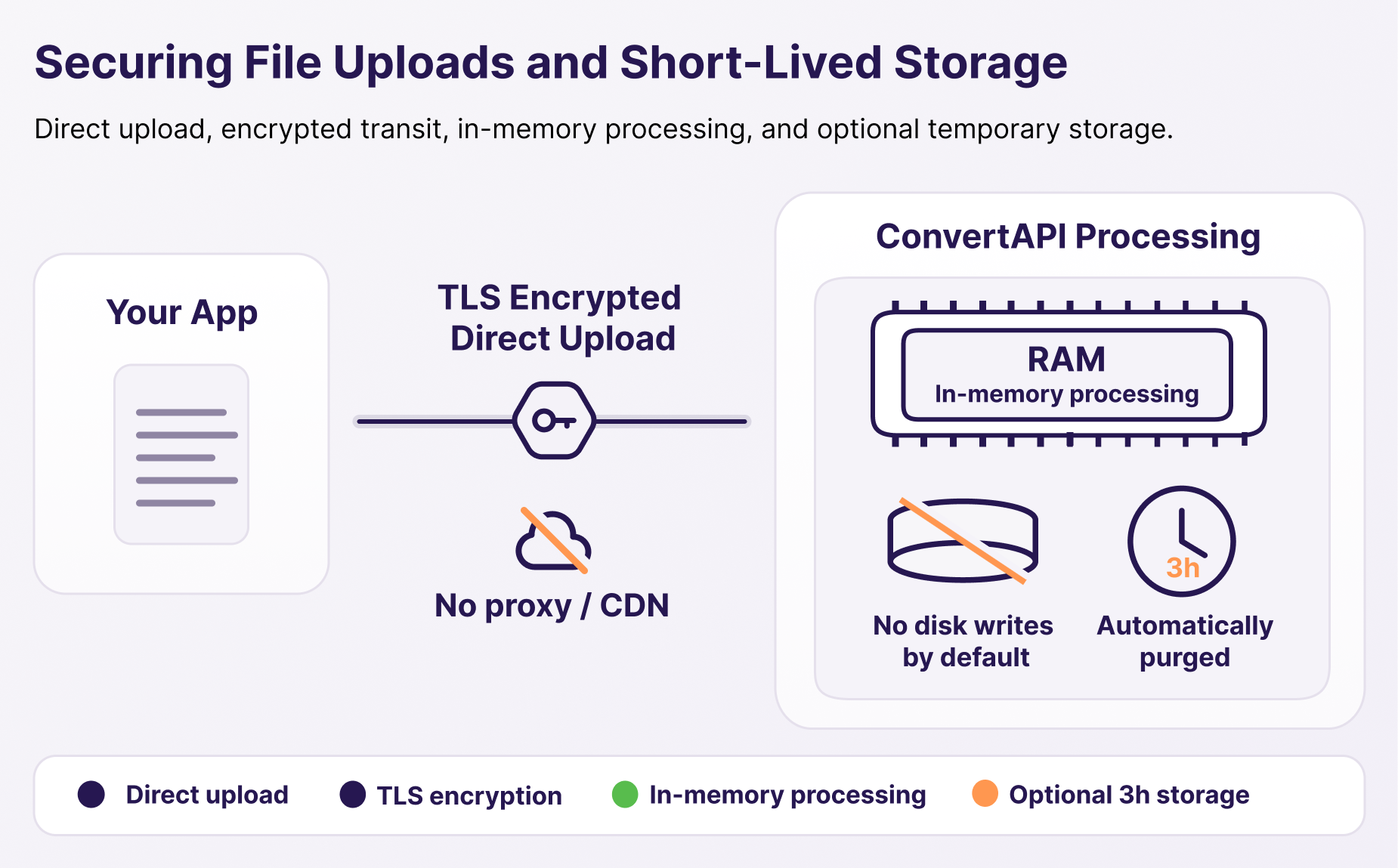
- Direct Uploads (No Intermediaries): Files are uploaded directly to ConvertAPI servers. We explicitly do not route your sensitive payloads through third-party upload proxy services or edge CDNs (like Cloudflare), eliminating unnecessary nodes from the data transit path and reducing the attack surface.
- Encrypted Communication: All communication with our REST API is strictly enforced over HTTPS. We mandate modern TLS 1.2 and TLS 1.3 protocols utilizing Perfect Forward Secrecy (PFS) and strong block ciphers (such as AES-GCM). This strict configuration consistently earns our endpoints an ‘A’ grade on SSL Labs.
- Secure IBM Datacenters: ConvertAPI’s bare-metal and cloud infrastructure is hosted in highly secure, fault-tolerant IBM datacenters. These facilities provide a robust physical foundation, backed by their own SOC 2 Type II and ISO 27001 compliance, to protect customer data and maintain high availability.
- In-Memory Processing by Default (StoreFile=false): By default, our service operates with a strict zero-storage footprint. When a request is made (or explicitly utilizing the StoreFile=false parameter), the file conversion is executed entirely in memory. Absolutely no file data is written to disk during the process.
- Optional & Non-Persistent Storage (StoreFile=true): If your specific workflow requires temporary hosting of the output file, you can opt-in by passing the StoreFile=true parameter. In this mode, files are non-persistently stored for a maximum of 3 hours before automated garbage collection permanently purges them. You always retain ultimate control: you can instantly remove these files at any time prior to the 3-hour mark via a simple API call.
Data Isolation and Processing Architecture
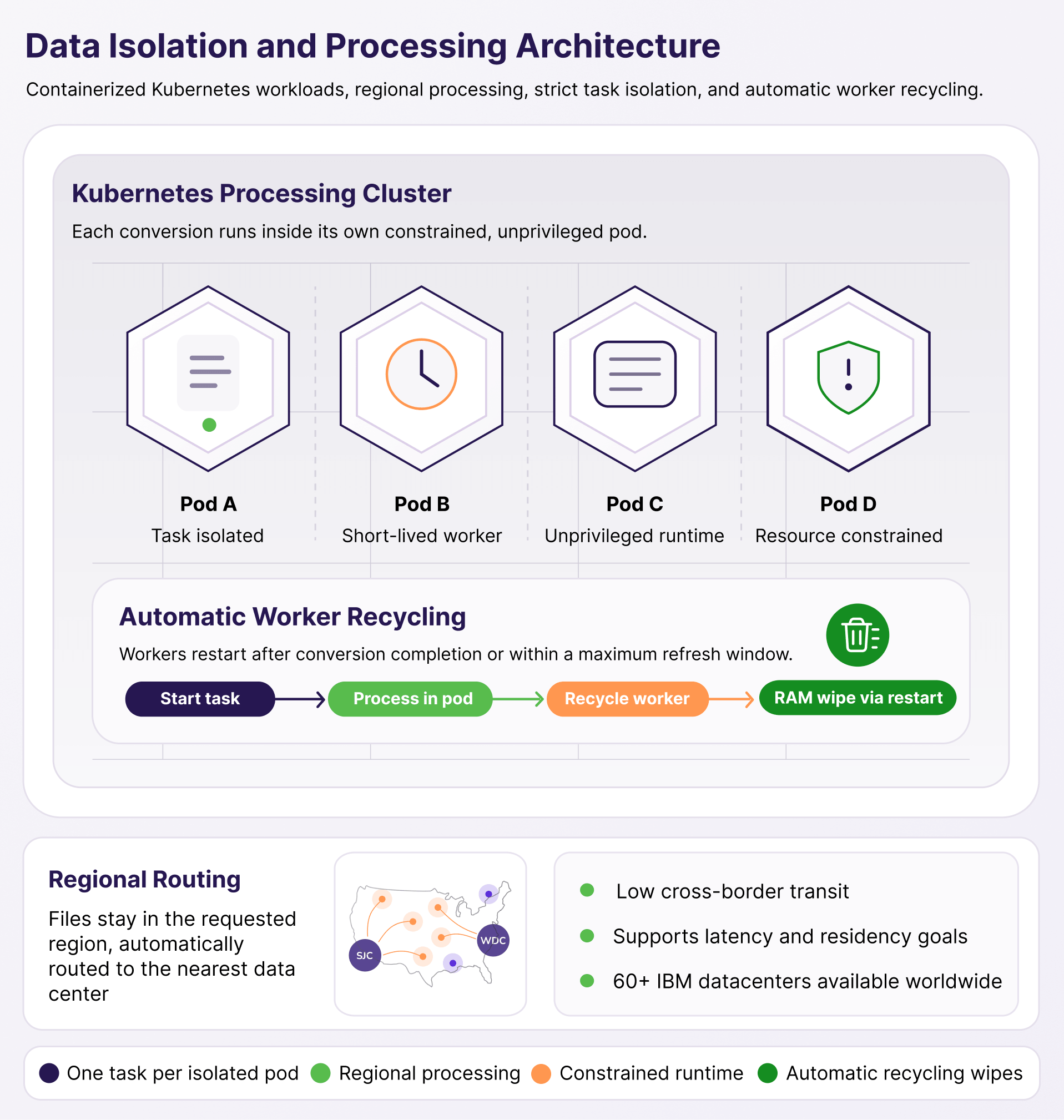
Once a file reaches us, it is processed securely without any risk of cross-contamination between different user workloads or execution environments.
- Containerized Non-Persistent Kubernetes Workloads: ConvertAPI processing engines run entirely on Kubernetes. By leveraging strict containerization (via Linux namespaces and cgroups), we enforce resource quotas and workload isolation. Each conversion task executes within its own constrained, unprivileged pod. More importantly, our Kubernetes workers are automatically restarted immediately after a conversion is completed (or at an absolute maximum of every 2 hours). This aggressive recycling process ensures that the server RAM is completely wiped, leaving zero residual data fragments in memory.
- Localized Regional Processing: We operate clusters across multiple geographic regions. When you make a request, files are routed and processed locally within that specific region. This minimizes cross-border data transit, ensuring low latency and helping you satisfy strict data residency requirements.
- Continuously Hardened Infrastructure: We maintain an automated CI/CD pipeline for infrastructure updates. We continuously patch our entire technology stack - from underlying hypervisor firmware up to the network stack, including our service mesh and Container Network Interfaces (CNI). This proactive, zero-downtime approach ensures we benefit from the latest security patches and minimize vulnerability exposure.
Encryption and Access Control
We employ zero-trust principles to govern system access, ensuring that only authenticated and authorized entities can interact with our endpoints.
- Encryption at Rest and in Transit: In transit, your payloads are protected by the aforementioned TLS encryption. If you opt into our short-lived storage (StoreFile=true), your files are encrypted at rest at the block level using robust AES-256 algorithms. Furthermore, production data is strictly segregated and never mirrored to staging or development environments.
- Authentication & Access Control: Access to our API is securely governed by API Tokens (passed securely via Authorization: Bearer headers) and JWTs (JSON Web Tokens) with cryptographically secure signatures. Within the ConvertAPI platform itself, we enforce a strict Role-Based Access Control (RBAC) architecture based on the principle of least privilege.
- Multi-Factor Authentication (MFA): To protect customer portals, billing information, and API key generation from credential stuffing or unauthorized access, we enforce MFA for all privileged internal accounts and strongly recommend it for all customer accounts.
Privacy-First Logging and Metadata
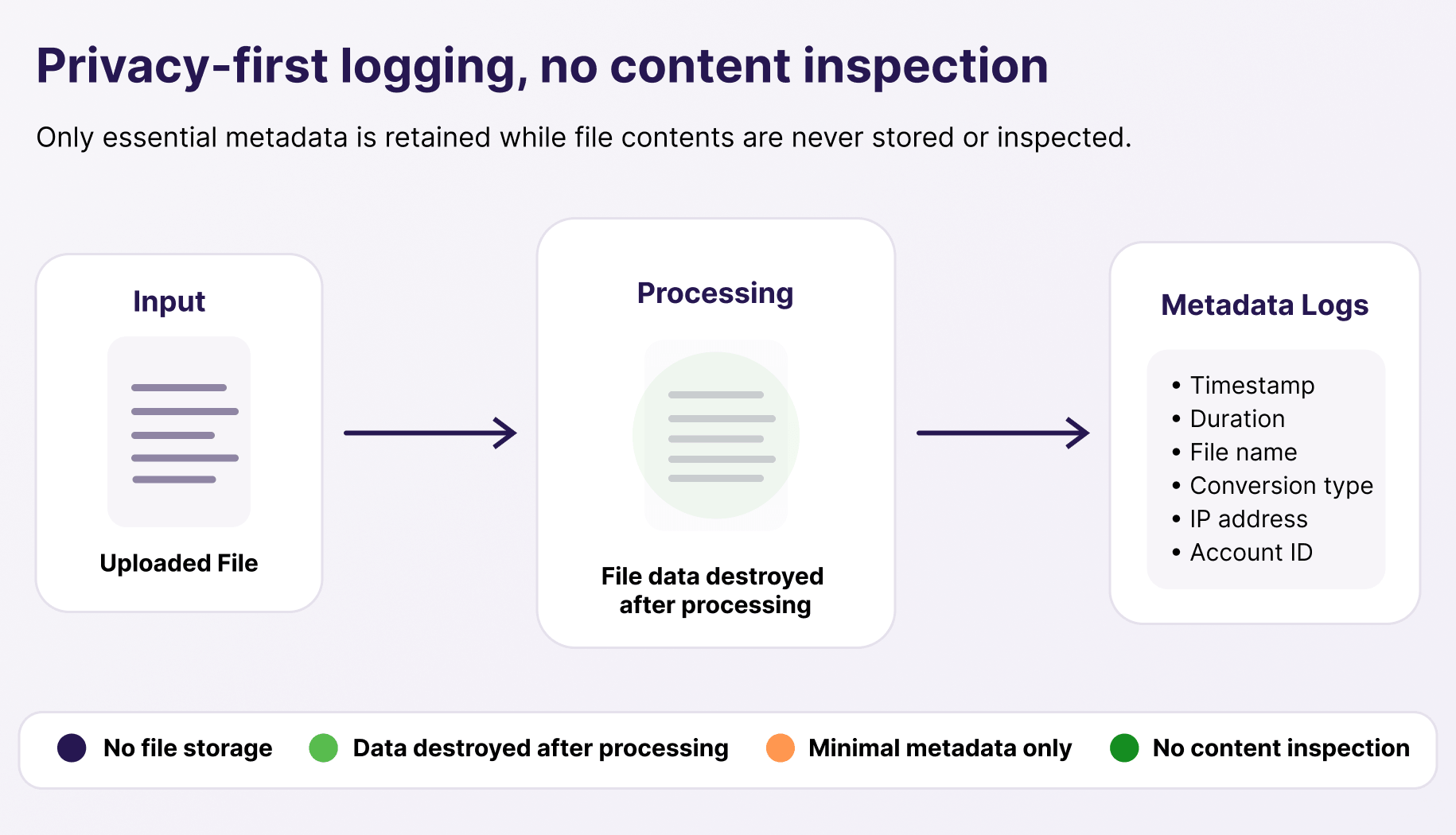
One of the most common questions from enterprise DevSecOps teams is: "What data do you retain after my file is converted?" The answer is simple: We do not mine, read, or store your files longer than you request. For auditing, billing, and system telemetry purposes, we log only the following strictly necessary metadata:
- Date and time of the conversion
- Execution time (duration of the conversion)
- Source file name
- Type of conversion performed
- IP address originating the API request
- Token / Account Identifier
Once the resulting file stream is returned to the client (or the temporary storage TTL/API deletion triggers), the actual file data is irrevocably destroyed. In case of in-memory conversion, the worker is restarted, and memory is wiped out. In case of non-persistent storage, either when you send a delete request or after 3 hours pass, we use the secure deletion function to remove the encrypted file from storage
Compliance: Built for the Enterprise
We understand that for healthcare, finance, and enterprise organizations, strict compliance is a legal necessity. ConvertAPI’s architecture is engineered to meet rigorous global regulatory frameworks:
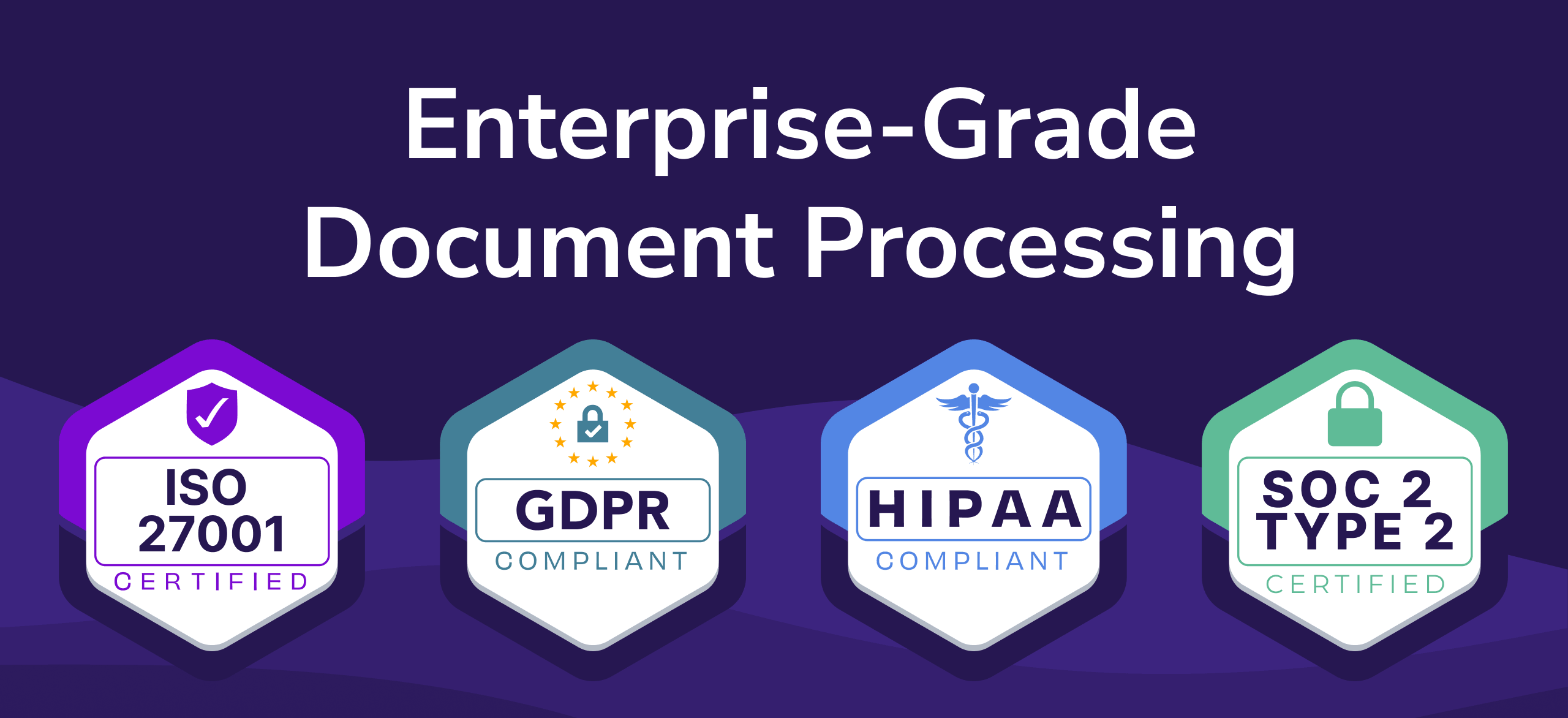
- ISO 27001: Our comprehensive Information Security Management System (ISMS) is ISO 27001 certified, ensuring standardized, audited operational controls around confidentiality, integrity, and availability.
- SOC 2: We are also SOC 2 certified, meaning our security protocols, access controls, and operational safeguards have been rigorously validated by independent auditors.
- GDPR: We are fully compliant with the General Data Protection Regulation. We provide standard Data Processing Agreements (DPAs) for our EU customers and limit data processing exclusively to what is technically necessary to execute the service.
- HIPAA: For healthcare providers and SaaS platforms dealing with Protected Health Information (PHI), our stateless processing model, in-memory execution, and strict encryption standards heavily support your HIPAA compliance requirements.

Monitoring, Logging, and Incident Response
Defense in depth requires constant telemetry and vigilance.
- 24/7 Monitoring & Rapid Response: We utilize centralized logging and distributed tracing to continuously monitor our infrastructure and API endpoints. Our dedicated security team utilizes automated alerting to react swiftly to any traffic anomalies or resource spikes.
- Independent Security Audits: We don’t just grade our own homework. Our software development lifecycle incorporates automated SAST/DAST scanning, and we commission regular technical security audits and penetration testing by independent, third-party cybersecurity firms.
- Service Transparency: Live service status, API latency metrics, and incident updates are always publicly available at status.convertapi.com.
Global Infrastructure and Data Residency
ConvertAPI operates a globally distributed infrastructure designed to keep data processing as close to the client as possible. Our platform can be deployed across 60+ IBM datacenters worldwide, providing a strong foundation for both performance and data residency. Through intelligent routing, requests are automatically handled within the nearest available region, reducing latency and minimizing unnecessary cross-border data transfer. For organizations with strict data sovereignty requirements, customers can explicitly select a regional endpoint aligned with their nearest data center, ensuring that data never leaves their country.
For Enterprise deployments with elevated security or compliance needs, ConvertAPI offers the option to run on dedicated private infrastructure. In this setup, the service is hosted on isolated servers accessible exclusively to a single customer, providing full control over data flow, custom environment configuration, and access boundaries.

Final Thoughts
Security is not just a feature of our service - it’s the foundational layer upon which the entire ConvertAPI platform is built. We handle the complexities of secure file processing, encryption, and continuous infrastructure patching so your engineering teams can focus on shipping features rather than defending infrastructure.
If you are evaluating ConvertAPI for an enterprise deployment, I invite you to explore our Security and Compliance page and Trust Center, where you can request access to our latest penetration test reports, DPAs, and compliance certificates.
Have deeper technical or compliance questions? Security is a collaborative effort. If your engineering or risk management teams need to dive deeper into our architecture, threat models, or privacy controls, I, as Chief Information Security Officer (CISO), am always available to speak with you directly. Just reach out to our support team to schedule a technical deep-dive.
We are proud to secure your data, so you can scale with confidence! Start converting your files today.