Watermark
Watermark PDF files - stamp a PDF with the text, image, or another fileExplore the product
ConvertAPI library for Ruby is designed to streamline even the most complex workflows, the library’s flexible parameters and straightforward configuration help you reduce development overhead, improve efficiency, and deliver high-quality results with minimal effort.
It is easy to start converting documents using Go in a few simple steps:
Sign up for free and receive 250 conversions to try and evaluate our service. You will receive a free trial with no credit card required upon registration!
On your account dashboard you will access an intuitive UI tool that allows you to set up the conversion, adjust the parameters, and try the conversion online with zero code.
Once you have set up the conversion parameters and are happy with the conversion results, you will receive an auto-generated Go code snippet with your custom parameters!
High-performance and unbeatable accuracy document converter suite with support for over 300+ conversion.
Generate dynamic DOCX and PDF documents like invoices, contracts, reports, on the fly.
Protect, redact, compare, watermark, flatten, compress and modify your documents using ConvertAPI Go SDK.
Protect and unprotect PDFs, MS Office Powerpoint and MS Office Word documents.
Built to scale with your business, whether you're handling a few conversions or thousands.
Reduce file sizes without losing quality. Archive converters are designed to handle over 100 different file formats.
Configure your file conversion directly online using our intuitive interface. Select the desired parameters and see the results in real-time. Once you're satisfied, we’ll automatically generate the Go code for you, making integration into your project effortless. No need to start from scratch - just copy the code and implement it seamlessly into your Go application!
Get started now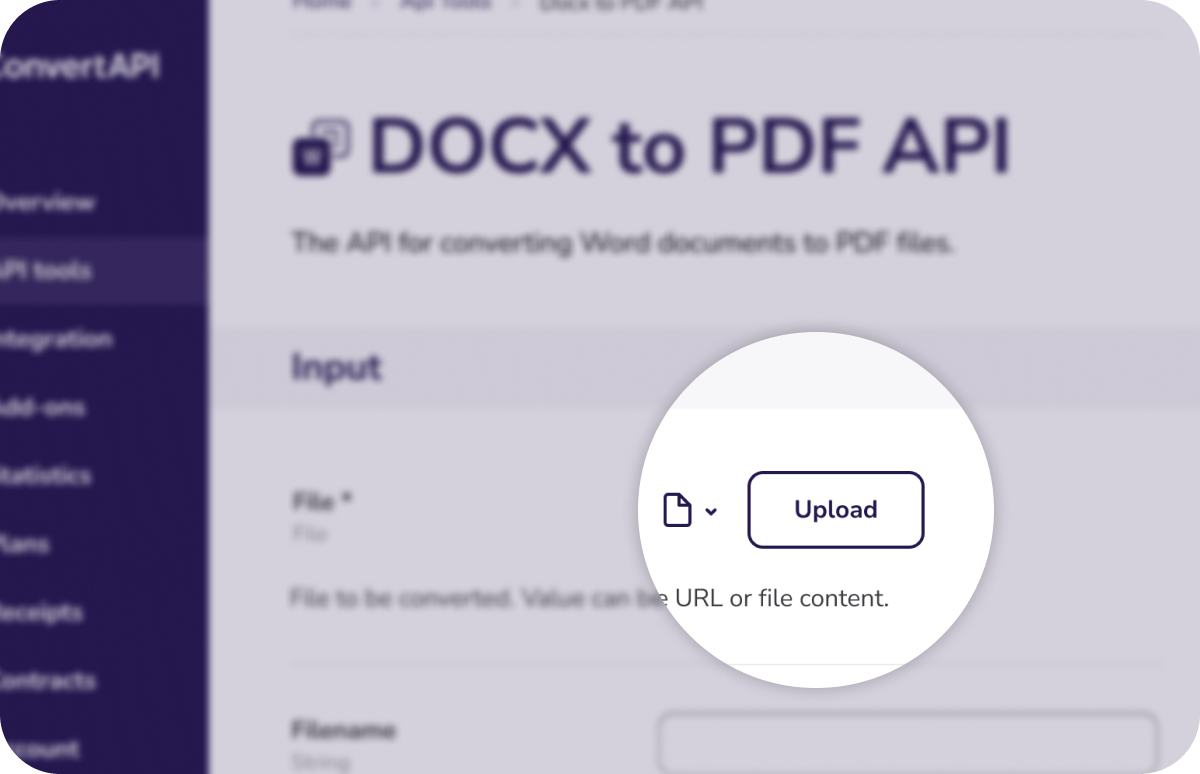
The ConvertAPI Go library delivers a comprehensive, developer-friendly solution for integrating powerful document conversion, manipulation, and management capabilities right into your Go applications. Designed with performance, simplicity, and scalability in mind, this library helps you handle a broad spectrum of file formats, ranging from PDFs and Office documents to images and beyond, through an intuitive and consistent API.
The library supports converting and processing hundreds of file types. Whether you need to transform PDFs into editable DOCX files, generate PDFs from images, or merge multiple documents into one streamlined output, the ConvertAPI Go library provides the versatility to handle diverse use cases without juggling multiple tools.
To get started, install the ConvertAPI Go dependency. Execute this command in your GOPATH:
go get github.com/ConvertAPI/convertapi-goThe ConvertAPI Go library makes it easy to combine multiple images into a single, cohesive PDF document with just a few lines of code. Whether you’re building a client-ready report from various visual assets, or consolidating a set of scanned pages into a single digital file, the library streamlines the entire process.
By allowing you to fine-tune parameters, such as page size, orientation, and image compression, you can produce a custom-tailored PDF that meets your exact requirements. Its intuitive API ensures that even complex tasks, like merging numerous high-resolution images, fit seamlessly into your Go-based workflows, letting you focus on delivering polished, professional-quality output to your users.
The following example demonstrates a multi-step conversion process, such as converting a DOCX file to PDF and then compressing the PDF, showcasing how to chain multiple conversions seamlessly. It is meant for complex workflows requiring multiple file transformations in a specific sequence.
ConvertApi.configure do |config|
  config.api_credentials = ENV['CONVERT_API_TOKEN'] # your api token
end

# Short example of conversions chaining, the PDF pages extracted and saved as separated JPGs and then ZIP'ed
# https://www.convertapi.com/doc/chaining

puts 'Converting PDF to JPG and compressing result files with ZIP'

jpg_result = ConvertApi.convert('jpg', {File: 'files/test.pdf'})

puts "Conversions done. Cost: #{jpg_result.conversion_cost}. Total files created: #{jpg_result.files.count}"

zip_result = ConvertApi.convert('zip', {Files: jpg_result.files})

puts "Conversions done. Cost: #{zip_result.conversion_cost}. Total files created: #{zip_result.files.count}"

saved_files = zip_result.save_files(Dir.tmpdir)

puts "File saved to #{saved_files}"Illustrates how to convert a file streams, eliminating the need for intermediate file storage. It's useful for applications that handle file data dynamically, such as web services or cloud-based systems, where writing to disk is undesirable.
func main() {
    config.Default = config.NewDefault(os.Getenv("CONVERTAPI_TOKEN")) // Get your token at https://www.convertapi.com/a

    fmt.Println("Converting HTML from the stream to TXT")

    reader := strings.NewReader("<!DOCTYPE html><html><head><title>My First Heading</title></head><body><h1>My First Heading</h1><p>My first paragraph.</p></body></html>\n")

    htmlRes := convertapi.ConvDef("html", "txt",
        // Reading source file body from the io.Reader
        param.NewReader("file", reader, "page.html", nil),
    )

        fmt.Println("TXT file content:")

    // Copy the content of the reader to stdout.
    if _, err := io.Copy(os.Stdout, htmlRes); err != nil {
        log.Fatalf("failed to copy data: %s", err)
    }
}This example illustrates how to convert a remote file, eliminating the need for intermediate file storage. It's useful for automating the conversion of files available online without manual intervention.
func main() {
	config.Default = config.NewDefault(os.Getenv("CONVERTAPI_TOKEN")) // Get your token at https://www.convertapi.com/a

	fmt.Println("Converting remote PPTX to PDF")
	pptxRes := convertapi.ConvDef("pptx", "pdf",
		param.NewString("file", "https://cdn.convertapi.com/public/files/demo.pptx"))

	if files, errs := pptxRes.ToPath("/tmp/converted.pdf"); errs == nil {
		fmt.Println("PDF file saved to: ", files[0].Name())
	} else {
		fmt.Println(errs)
	}
}The following example demonstrates how to perform multiple file conversions concurrently, leveraging Go's concurrency features to enhance performance. It is ideal for scenarios requiring the conversion of numerous files simultaneously, such as bulk processing tasks.
func main() {
	config.Default = config.NewDefault(os.Getenv("CONVERTAPI_TOKEN")) // Get your token at https://www.convertapi.com/a

	fmt.Println("Converting DOCX to PDF and JPG in parallel using same source file")
	fileParam := param.NewPath("file", "assets/test.docx", nil)
	pdfRes := convertapi.ConvDef("docx", "pdf", fileParam)
	jpgRes := convertapi.ConvDef("docx", "jpg", fileParam)

	// Downloading and saving files also in parallel
	c1 := save(pdfRes)
	c2 := save(jpgRes)
	<-c1
	<-c2
}

func save(res *convertapi.Result) (finish chan struct{}) {
	finish = make(chan struct{})
	go func() {
		defer close(finish)
		if files, errs := res.ToPath("/tmp"); errs == nil {
			fmt.Println("File saved to: ", files[0].Name())
		} else {
			fmt.Println(errs)
		}
	}()
	return
}The following example demonstrates a multi-step conversion process, such as converting a DOCX file to JPG and then compressing the JPG files into a ZIP archive, showcasing how to chain multiple conversions seamlessly.
func main() {
	config.Default = config.NewDefault(os.Getenv("CONVERTAPI_TOKEN")) // Get your token at https://www.convertapi.com/a

	fmt.Println("Converting PDF to JPG and compressing result files with ZIP")

	jpgRes := convertapi.ConvDef("docx", "jpg", param.NewPath("file", "assets/test.docx", nil))

	zipRes := convertapi.ConvDef("jpg", "zip", param.NewResult("files", jpgRes, nil))

	if cost, err := jpgRes.Cost(); lib.PrintErr(err) {
		fmt.Println("DOCX -> JPG conversion cost: ", cost)
	}

	if files, err := jpgRes.Files(); lib.PrintErr(err) {
		fmt.Println("DOCX -> JPG conversion result file count: ", len(files))
	}

	if cost, err := zipRes.Cost(); lib.PrintErr(err) {
		fmt.Println("JPG -> ZIP conversion cost: ", cost)
	}

	if files, errs := zipRes.ToPath("/tmp/result.zip"); errs == nil {
		fmt.Println("ZIP file saved to: ", files[0].Name())
	} else {
		fmt.Println(errs)
	}
}
With our Go SDK, you can tap into a comprehensive set of over 500 document conversion and management capabilities - all neatly organized within one cohesive platform.
With our Go library, you can effortlessly handle documents sourced from URLs, file streams, or local paths, ensuring smooth integration with your existing environment. To optimize your workflow even further, consider employing conversion workflows that allow you to perform multiple, sequential transformations on the same document.
For detailed examples and advanced guidance, don’t forget to check our GitHub repository.
Take control of your documents with our Go document management SDK. From basic conversions to full workflow automation, we provide the expertise and tools you need to manage your documents efficiently.
Explore the product
Explore the product
Explore the product
Explore the product
Explore the product
Explore the product
Explore the product
Explore the product
Explore the product
Explore the product
Explore the product
Explore the product
Explore the product
Explore the product
Explore the product
Explore the product
Explore the product
Explore the product
Explore the product
Explore the product
Explore the product
Explore the product
Explore the product
Explore the product
Explore the product
Explore the product
Explore the product
Explore the product
Explore the product
Explore the product
Explore the product
Explore the product
Explore the product
Explore the product
Explore the product
Explore the product
Explore the product
Explore the product
Explore the product
Explore the product
Explore the product
Explore the product
Explore the product
Explore the product
Explore the product
Explore the product
Explore the product
Explore the product
Explore the product
Explore the product
Explore the product
Explore the product
Explore the product
Explore the product
We ensure that all document processing is handled securely in the cloud, adhering to industry-leading standards like ISO 27001, GDPR, and HIPAA. To enhance security even further, we can ensure that no files or data are stored on our servers and never leave your country.
Learn more about securityHighest rated File Conversion API on major B2B software listing platforms: Capterra, G2, and Trustpilot.
"ConvertAPI has been a game-changer for our document automation workflows. Their conversion accuracy and API reliability are unmatched in the industry for over 7 years."

"ConvertAPI is a reliable, cost-effective solution with a proven track record of stability. It has grown significantly in maturity, adopting enterprise-grade practices over the years."

"We've integrated ConvertAPI across our entire document processing platform. The performance is exceptional and the support team is always responsive. Highly recommended!"

Whether you’re running monolithic apps or microservices, you can integrate it quickly by importing the library, setting your credentials, and invoking straightforward conversion methods. Its compatibility with standard Go tooling and package management ensures a smooth setup process.
Yes. Taking advantage of ConvertAPI's concurrency model, you can process conversions concurrently with goroutines, significantly boosting throughput for large workloads. This makes it easier to scale your document processing and reduce overall execution time.
Absolutely. In addition to standard conversions, the Go SDK supports advanced features such as redacting sensitive information and running OCR on scanned documents. These capabilities help consolidate various document workflows under one cohesive toolset.
The Go SDK is built for efficiency and robustness. It can handle big files and high volumes of conversions without sacrificing speed. You can also configure memory usage and file streaming options, ensuring consistent performance even under heavy loads.
Yes. You can create conversion workflows that apply a series of transformations to the same document. For example, you might convert a DOCX to PDF, apply protection, then compress the output, all within a single, orchestrated process.
Our GitHub repository and official documentation include code samples and best practices for a range of use cases. These resources help you quickly experiment, learn, and refine your approach as you tailor the SDK to your project’s unique needs.